
The full, journalistically authored feature article has already been published in several renowned industry and trade media outlets:
-
- Elektrotechnik Automatisierung (online, April 7, 2026)
- Industrial Production (online, 19.05.2026)
Precision, dynamics, and efficiency as drivers of modern drive technologies
Robotics is advancing at a rapid pace—from industrial applications to collaborative systems. Modern robots must operate with ever-greater precision, dynamism, and energy efficiency. At the same time, demands on installation space, weight, and thermal performance are increasing. Meanwhile, demands on installation space, weight, and thermal performance are increasing.
At the heart of this development are high-performance lamination stacks. As the core components of stators and rotors, they play a key role in the performance of electric drives. Innovative manufacturing and assembly technologies are opening up new possibilities for efficiency, precision, and scalability.
Robotics in Transition: Demanding Requirements for Electric Drives
Whether industrial robots, cobots, or autonomous systems—modern robotic solutions require highly dynamic drives with precise positioning accuracy. At the same time, vibrations, noise emissions, and energy losses must be minimized.
This becomes particularly evident in applications involving fast motion cycles and high repeatability. The quality of the lamination stacks used directly impacts the efficiency, smoothness, and service life of drive systems. At the same time, traditional manufacturing approaches are increasingly reaching their limits — especially when dealing with complex geometries and rising efficiency requirements.
Facts
- Segmented stators enable highly dynamic, precise, and energy-efficient robotic drives
- Bonding varnish (Backlack) ensures low-vibration drives with optimized, smooth operation.
- Optimized lamination stacks minimize magnetic losses and maximize power density
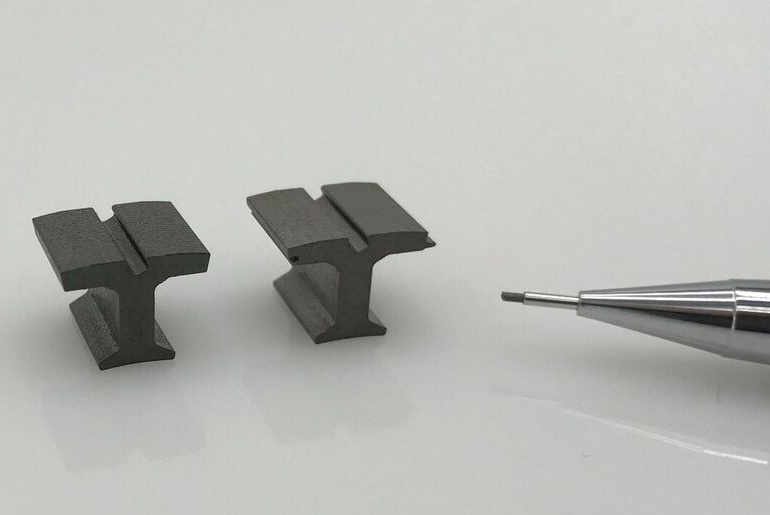
Segmented stators provide maximum dynamics and flexibility
A key innovation lies in segmented stators. By manufacturing individual segments, winding processes can be optimized and higher copper fill factors achieved. The result is motors with higher power density, improved dynamics, and greater efficiency.
In addition, segmentation enables a high degree of design flexibility, which is a key advantage for compact, highly integrated robotic systems. It also improves manufacturing reproducibility, which is important as production volumes increase.
Bonding Varnish (Backlack) Technology for Precision and Smooth Operation
Bonding varnish plays a key role in the production of high-precision lamination stacks. Full-surface bonding of the individual laminates creates stable, dimensionally accurate lamination stacks.
For robotics applications, this translates to reduced vibration and noise levels, as well as smoother motor operation overall. The improved mechanical properties also allow for narrower air gaps between the stator and rotor, further increasing efficiency.
Minimizing magnetic losses to increase efficiency
In highly dynamic robotic systems, magnetic losses are a critical factor in energy efficiency and thermal performance. Modern manufacturing technologies ensure the highest edge quality and prevent material-related defects.
The use of thin lamination stacks and specialized materials further reduces losses and improves drive performance, especially in applications with high cycle rates and continuous operation.
Scalable Production for Industrial Robotics and Cobots
In addition to technical performance, cost-effective manufacturing is also becoming increasingly important. Modular machine designs and automated processes enable flexible production—from small batches to large volumes.
In the rapidly innovating and dynamically growing robotics market, scalable manufacturing solutions provide a decisive competitive advantage. Original equipment manufacturers (OEMs) benefit from greater flexibility, stable processes, and shorter time-to-market.
Conclusion
Robotics places the highest demands on precision, dynamics, and energy efficiency. Advanced manufacturing technologies for lamination stacks, combined with segmented stators and bonding varnish, enable a new generation of high-performance electric drives.
This results in solutions that are technically, economically, and environmentally sound. They also lay the foundation for the next stage in the evolution of modern robotic systems.
Ready for the next generation of robotic drive systems?
High-performance, energy-efficient, and highly dynamic drives for modern robotics applications are enabled by precision-engineered lamination stacks, segmented stators, and innovative bonding varnish (Backlack) technologies.
Talk to our experts about your needs—from prototype development to scalable mass production.
Contact us today to learn more about our robotics drives.